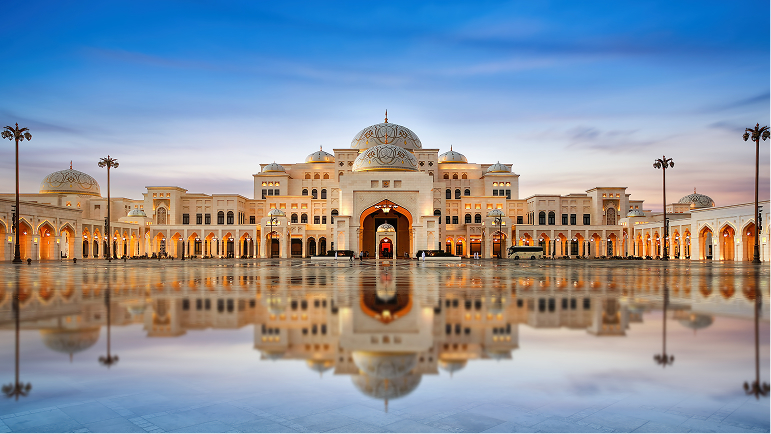
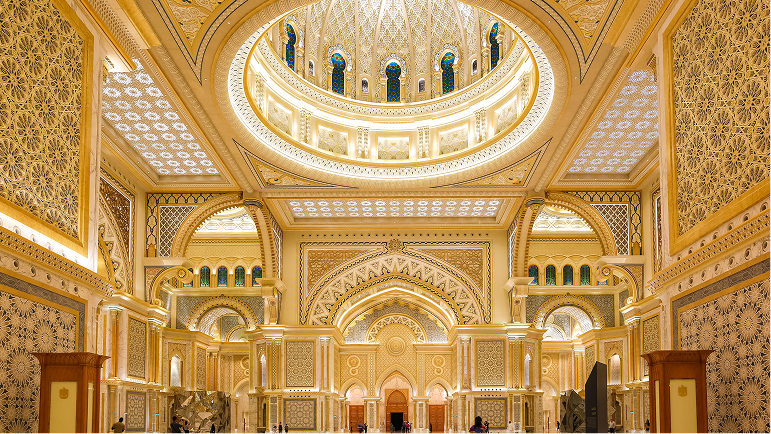
Opened to the public in 2019, the palace remains a functioning seat of government, transparent yet grand by design. The Great Hall forms the central axis of the palace – 100 meters across in both directions, with a dome 37 meters wide and nearly 60 high. Four mirrored volumes anchor the corners, catching arches and mosaics in measured repetition. The dome rests on eight load-bearing pillars, dividing the floor into equal parts while keeping the space open and legible. Natural light draws out colour from below: blue for the Gulf, white for clarity, yellow for desert light.
By the time you’ve gasped a few times already, the palace leads you into its clearest message: the Spirit of Collaboration chamber. Circular by design, with no seat at the head, this is where the UAE’s Federal Supreme Council meets, and where regional summits gather face to face. The space invites parity by architecture alone. Above, a three-storey chandelier made of 350,000 crystals hangs in quiet suspension, assembled on site, its weight absorbed into the stillness.
Just off the main axis, the sound softens and the ceiling lowers. The library opens without ceremony: tall shelves holding around 50,000 volumes across law, history, the social sciences, philosophy, and the arts. Light falls evenly across the reading desks. It’s open to the public, with membership services and research terminals that quietly frame it as part of the country’s working life. A few steps away, the House of Knowledge places texts in quiet conversation: a replica of the early Birmingham Quran, pages from the Bible and the Psalms of David, early Arabic manuscripts on astronomy, science, and literature.
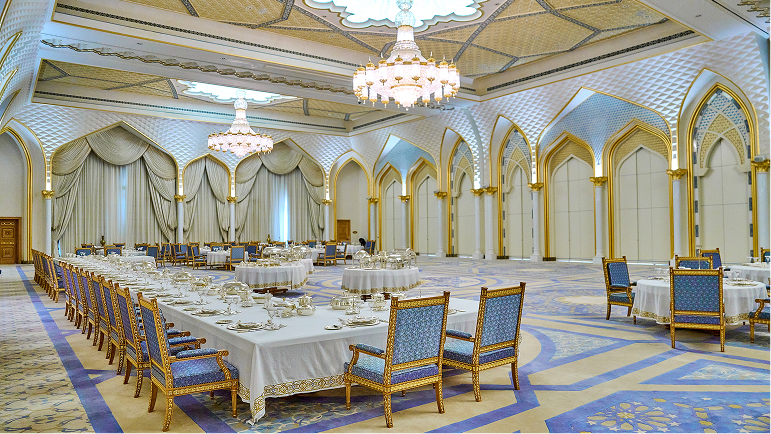
In the Presidential Gifts gallery, you see how nations talk without words: samurai armour from Japan, falcon hoods, coins, carpets, ceremonial pieces. Each one was chosen to say something, then placed under glass with a small note – who gave it, when, and why. Nearby, the Presidential Banquet Room shows hospitality as choreography: the host sits at the centre, the guest of honour to the right, with circular tables spreading outward so no one turns their back. Up to 300 guests can be seated here, each with place settings drawn from more than 100,000 pieces of custom-made serveware: silver, crystal, bone china.
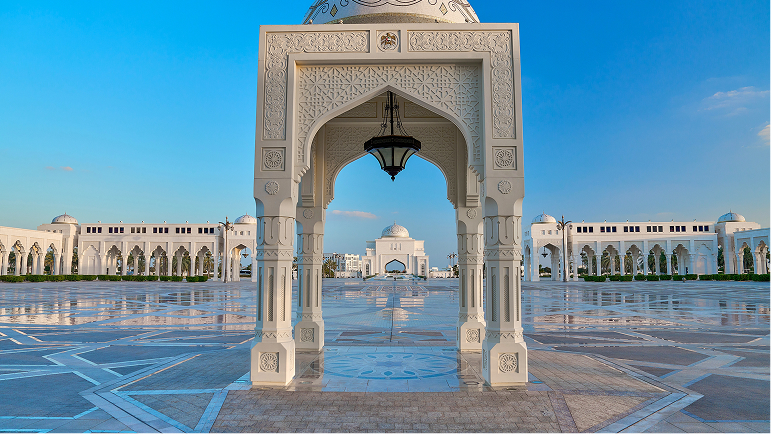
Outside, the white granite and limestone exterior holds its sharpness even in late sun, designed to reflect heat and match the city’s pale coastal light. From the main forecourt, the palace reads as symmetrical, monumental, almost still – until night falls. Then the façade begins to move. ‘Palace in Motion’, a short light and sound show projected across the front, plays out in three acts: the nation’s past, its present, and a closing gesture toward the future. It lasts under ten minutes and says very little out loud. But if you’ve just walked the building, you already know what it means.

.svg)


.jpg)




.jpg)


.jpg)

.webp)

.webp)




.webp)
.webp)

.webp)

_11zon.jpeg)
.jpg)
.jpeg)
.webp)

.jpg)


.webp)



.webp)
.webp)



.webp)
.webp)
%20(2).webp)
.webp)
.webp)
.webp)

.webp)
.webp)
.webp)
.webp)
.webp)


.png)
.png)
